
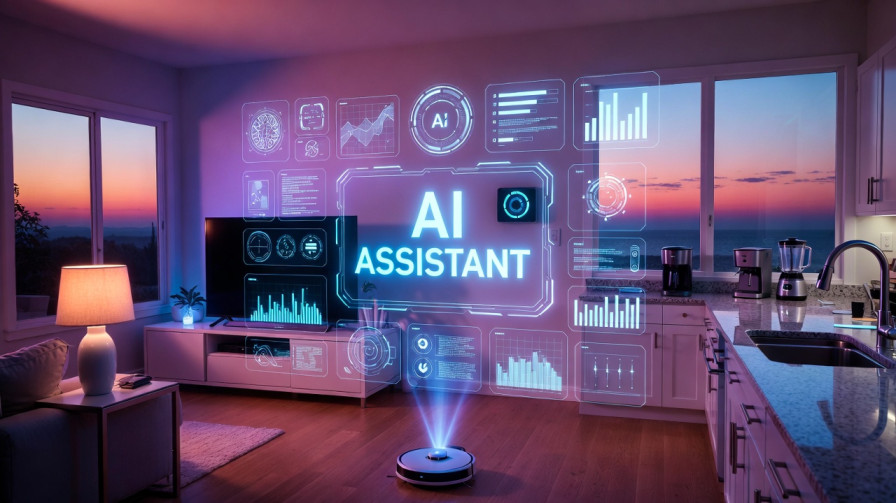
The future of home management is here—intelligent assistants that handle everything from vacuuming your floors to organizing your grocery lists
The average person spends over 28 hours per week on household chores, according to recent studies. But in 2026, artificial intelligence is fundamentally transforming this reality. Smart home assistants powered by advanced AI are no longer just voice-activated speakers—they’re comprehensive household management systems that anticipate needs, automate tasks, and free up precious time for what truly matters.
From AI-powered robotic vacuum cleaners that map your entire home to intelligent kitchen assistants that plan meals and generate shopping lists, the integration of artificial intelligence into domestic life has moved from science fiction to everyday reality. This revolution isn’t just about convenience—it’s about reclaiming time, reducing mental load, and creating smarter, more efficient living spaces.
Let’s explore how these intelligent systems are reshaping the way we manage our homes, which tasks they’re mastering, and what this means for the future of household management.
The Evolution of Smart Home Assistants
Smart assistants have undergone a dramatic transformation since Amazon Echo and Google Home first entered homes in the mid-2010s. What began as simple voice-controlled devices capable of setting timers and playing music has evolved into sophisticated AI systems with multi-modal capabilities and contextual understanding.
From Voice Commands to Predictive Intelligence
Modern AI assistants leverage machine learning algorithms to understand household patterns, predict needs, and take proactive action. They’ve moved beyond reactive command-response models to become genuinely intelligent helpers that:
- Learn your routines: AI systems now recognize when you typically wake up, leave for work, or prepare meals, automatically adjusting home settings accordingly
- Understand context: Natural language processing has advanced to the point where assistants grasp nuanced requests and maintain context across conversations
- Integrate across platforms: Seamless connectivity allows one assistant to control lighting, temperature, security, entertainment, and appliances from a unified interface
- Adapt to preferences: Continuous learning means your assistant becomes more personalized over time, understanding individual family members’ unique needs
📊 Market Insight: The global smart home market is projected to reach $174 billion by 2026, with AI-powered assistants serving as the central control hub in over 65% of smart homes worldwide.
Cleaning and Home Maintenance: The First Domain Conquered

If there’s one area where AI has made the most visible impact, it’s in automated cleaning and home maintenance. The days of manual vacuuming, mopping, and constant tidying are rapidly becoming optional rather than mandatory.
Intelligent Robotic Cleaners
Modern robotic vacuum cleaners and mops bear little resemblance to their early predecessors that bumped randomly around rooms. Today’s AI-powered cleaning robots feature:
🗺️ Advanced Mapping
LiDAR and camera-based navigation create detailed 3D maps of your home, enabling efficient cleaning paths and room-specific scheduling
🧹 Surface Recognition
AI identifies carpet versus hardwood, automatically adjusting suction power and switching between vacuuming and mopping modes
🚫 Obstacle Avoidance
Computer vision detects and navigates around shoes, cables, pet waste, and other obstacles without getting stuck
Predictive Maintenance Systems
Beyond active cleaning, AI assistants now monitor home systems and predict maintenance needs before problems occur:
- Smart HVAC systems that detect filter degradation and schedule replacements
- Water leak sensors integrated with AI analysis to identify potential plumbing issues
- Appliance monitoring that predicts component failures weeks in advance
- Automated scheduling of professional maintenance based on usage patterns
💡 Real-World Example: Sarah, a working mother of two, reports saving 8 hours per week since implementing an AI cleaning ecosystem. Her robotic vacuum and mop run automatically during work hours, while smart sensors alert her to maintenance needs before they become emergencies. “I haven’t manually vacuumed in six months,” she notes.
Kitchen Intelligence: Meal Planning and Food Management
The kitchen has become ground zero for AI innovation in the home. From smart refrigerators that track inventory to AI sous chefs that guide cooking, artificial intelligence is transforming how we approach food preparation and management.
Automated Meal Planning and Grocery Management
One of the most time-consuming aspects of household management—deciding what to eat and ensuring ingredients are available—is being revolutionized by AI:
How AI Meal Planning Works
- Inventory Tracking: Smart cameras inside refrigerators identify items, track expiration dates, and monitor quantities
- Preference Learning: AI analyzes family eating patterns, dietary restrictions, and taste preferences over time
- Recipe Suggestions: Systems recommend meals based on available ingredients, minimizing waste and shopping trips
- Automated Ordering: Integration with grocery delivery services enables one-click ordering or fully automatic replenishment
- Nutritional Optimization: AI ensures meal plans meet dietary goals and nutritional requirements for all family members
Smart Cooking Assistance
AI-enabled cooking appliances and assistants are making gourmet-level cooking accessible to everyone:
- Precision cooking devices: Smart ovens and cooktops that adjust temperature and timing based on what you’re preparing
- Visual cooking guidance: Screen-equipped assistants that provide step-by-step video instructions synchronized with your cooking progress
- Voice-guided recipes: Hands-free cooking assistance that responds to questions and adjusts for substitutions in real-time
- Multi-device orchestration: Coordinating multiple appliances to have all components of a meal ready simultaneously
⚠️ Important Consideration: While AI excels at recipe suggestions and timing, food safety remains a human responsibility. Always verify cooking temperatures for meat and perishables, and don’t rely solely on AI for critical safety decisions.
Laundry and Wardrobe Management
Laundry might seem like a simple task, but between sorting, washing, drying, folding, and organizing, it consumes significant time. AI is streamlining this entire process in surprising ways.
Intelligent Washing and Drying
Modern AI-powered laundry appliances do far more than just spin clothes:
🔍 Fabric Detection
AI identifies fabric types through load sensors and adjusts water temperature, cycle intensity, and detergent recommendations automatically
⚡ Energy Optimization
Systems learn utility rate structures and schedule heavy washing during off-peak hours, reducing energy costs by up to 30%
📱 Smart Notifications
Alerts when loads are complete, reminders to move clothes to the dryer, and warnings about items left in pockets
Automated Folding and Organization
While still emerging, robotic folding systems and smart closet organizers are beginning to tackle the final frontier of laundry automation:
- AI-powered folding robots that handle t-shirts, pants, and towels with near-human precision
- Smart closets that recommend outfits based on weather, calendar appointments, and style preferences
- Digital wardrobe inventories that track what you own and suggest donation candidates
- Automated dry cleaning scheduling based on garment care requirements and wearing frequency
Climate Control and Energy Management
Heating, cooling, and managing home energy consumption represents a significant ongoing chore that AI has transformed into a completely automated background process.
Intelligent Thermostats and Climate Systems
Smart thermostats like Nest, Ecobee, and others use sophisticated AI algorithms to maintain comfort while minimizing energy waste:
Key Capabilities of AI Climate Control
Feature |
How It Works |
|---|---|
Occupancy Learning |
Sensors detect when people are home and adjust temperatures accordingly, avoiding waste when spaces are empty |
Weather Integration |
Forecasts guide pre-cooling or pre-heating decisions, optimizing comfort and efficiency |
Zone Management |
Different temperatures for different rooms based on usage patterns and preferences |
Energy Price Awareness |
Shifts heating/cooling to off-peak hours when electricity rates are lower |
The result is hands-off climate management that learns your preferences and adapts automatically. Homeowners report energy savings of 15-25% on average, while never having to manually adjust the thermostat.
Whole-Home Energy Optimization
Beyond climate control, AI systems now manage entire home energy ecosystems:
- Smart lighting that adjusts based on natural light levels and room occupancy
- Appliance scheduling to balance loads and minimize peak demand charges
- Solar panel and battery storage optimization for maximum renewable energy utilization
- Real-time energy monitoring with alerts about unusual consumption patterns
Home Security and Monitoring
What used to require manual checking of locks, setting alarm systems, and reviewing security footage has become an AI-managed background process that actively protects your home.
Intelligent Security Systems
Modern AI security goes far beyond simple motion detection:
👤 Person Recognition
AI distinguishes between family members, expected visitors, delivery personnel, and unknown individuals
🚨 Behavioral Analysis
Systems learn normal patterns and alert to suspicious behavior like loitering or repeated approaches
🔐 Automated Responses
Smart locks, lights, and cameras coordinate to secure the home when you leave or alert you to issues
Proactive Home Monitoring
AI assistants continuously monitor for potential problems:
- Smoke and carbon monoxide detection with intelligent alerts that distinguish cooking smoke from actual fires
- Water leak monitoring that shuts off main valves automatically when leaks are detected
- Air quality tracking with automatic ventilation adjustments based on pollutant levels
- Pet monitoring that tracks animal behavior and alerts to health concerns or unusual activity
💡 Practical Tip: Set up your AI security system with multiple family member profiles to avoid false alarms. The more the system learns about regular household patterns, the more accurate its threat detection becomes.
Personal Organization and Task Management
Beyond physical chores, AI assistants excel at managing the mental load of running a household—the planning, scheduling, and coordination that often goes unnoticed but consumes significant cognitive energy.
Calendar and Scheduling Intelligence
AI assistants have evolved into sophisticated personal secretaries that manage family logistics:
- Automatic appointment scheduling that considers commute times, conflicts, and preferences
- Family calendar coordination that prevents double-bookings and ensures everyone knows the plan
- Intelligent reminders based on location, time, and task context
- Event preparation assistance, from sending RSVPs to setting up the home for guests
Shopping and Errands Automation
AI has transformed shopping from a time-consuming chore into a mostly automated background process:
How AI Manages Shopping
Recurring Purchases: Systems track consumption rates of household staples (toiletries, cleaning supplies, pantry items) and automatically reorder before you run out.
Price Optimization: AI monitors prices across retailers, ordering from the most cost-effective source and alerting you to sales on items you regularly purchase.
Consolidated Delivery: Smart ordering systems batch purchases to minimize delivery trips and packaging waste.
Gift Management: AI remembers birthdays, anniversaries, and special occasions, suggesting appropriate gifts based on recipient preferences and budget.
Bill Payment and Financial Tracking
Managing household finances is another chore AI assistants are increasingly handling:
- Automated bill payment with fraud detection and unusual charge alerts
- Budget tracking and spending analysis with recommendations for optimization
- Subscription monitoring that identifies unused services and suggests cancellations
- Tax preparation assistance through document organization and expense categorization
Childcare and Elder Care Support
For families with children or elderly relatives, AI assistants provide valuable support that goes beyond simple convenience to genuine caregiving assistance.
AI-Assisted Childcare
While AI never replaces human supervision, it provides valuable support for parents:
📚 Educational Support
AI tutors that help with homework, adapt to learning styles, and provide patient explanations of difficult concepts
🎮 Safe Entertainment
Content curation that ensures age-appropriate media, with parental controls and screen time management
👁️ Activity Monitoring
Alerts when children enter unsafe areas, with emergency contact capabilities and location tracking
Elder Care and Health Monitoring
AI systems provide crucial support for aging family members, enabling longer independent living:
- Medication reminders: Intelligent dispensers that ensure proper dosage and timing while alerting caregivers to missed doses
- Fall detection: Sensors that recognize falls and automatically contact emergency services or family members
- Health tracking: Monitoring of vital signs, sleep patterns, and activity levels with anomaly detection
- Companionship: Conversational AI that provides social interaction and cognitive stimulation
- Appointment coordination: Managing doctor visits, prescription refills, and medical follow-ups
⚠️ Critical Note: AI care support tools are assistive technologies, not replacements for human caregivers. They work best as part of a comprehensive care plan that includes regular human interaction and professional medical oversight.
The Cost-Benefit Analysis of AI Home Automation
While the benefits of AI-powered home management are compelling, implementing these systems requires both financial investment and adjustment to new ways of living. Understanding the full picture helps make informed decisions.
Initial Investment Considerations
The upfront costs for comprehensive AI home automation vary widely:
Typical Cost Ranges (2026)
- Entry-level setup ($500-$1,500): Smart speaker, intelligent thermostat, robotic vacuum, basic security cameras
- Mid-range system ($2,500-$5,000): Comprehensive climate control, advanced cleaning robots, smart appliances, integrated security
- Premium ecosystem ($7,000-$15,000+): Whole-home automation, AI cooking assistants, automated window treatments, advanced energy management
- Ongoing costs: Subscription services for advanced features, cloud storage, and professional monitoring typically run $10-$50/month
Measurable Returns
The value proposition extends beyond mere convenience:
- Time savings: Most households report reclaiming 10-20 hours per week previously spent on chores
- Energy cost reduction: Average savings of 15-30% on utility bills through intelligent management
- Food waste reduction: AI meal planning and inventory tracking cuts food waste by 30-40%
- Preventive maintenance savings: Early problem detection prevents costly emergency repairs
- Home value increase: Smart home features can add 3-5% to resale value
Intangible Benefits
Beyond financial metrics, AI home automation delivers quality-of-life improvements:
- Reduced mental load from constant household management decisions
- More quality time with family instead of chore time
- Decreased stress from forgotten tasks or emergencies
- Greater accessibility for people with mobility or cognitive challenges
- Peace of mind from continuous home monitoring
Privacy, Security, and Ethical Considerations
The convenience of AI-powered homes comes with legitimate concerns about data privacy, security vulnerabilities, and the broader implications of increasing automation in domestic life.
Data Privacy Concerns
AI assistants necessarily collect extensive data about household routines, preferences, and behaviors. Key privacy considerations include:
⚠️ Privacy Protection Strategies:
- Review and limit data sharing permissions to essential functions only
- Use devices from manufacturers with strong privacy policies and transparent data practices
- Regularly audit connected devices and remove unused ones from your network
- Create separate network segments for IoT devices versus personal computers
- Enable two-factor authentication on all smart home accounts
Security Vulnerabilities
Connected devices create potential entry points for cyber attacks. Protect your smart home by:
- Keeping all device firmware and software updated to patch security vulnerabilities
- Using strong, unique passwords for each smart home account and device
- Securing your home WiFi network with WPA3 encryption and a strong password
- Disabling features you don’t use to minimize potential attack surfaces
- Considering devices with local processing capabilities to reduce cloud dependencies
Broader Societal Implications
The automation of domestic labor raises important questions:
- Economic impact: How will AI displacement of household service jobs affect employment?
- Skill erosion: What happens when generations grow up without learning basic household management?
- Digital divide: Will AI home automation create greater inequality between those who can afford it and those who cannot?
- Environmental concerns: Does the energy saved through optimization offset the manufacturing and disposal impact?
- Human connection: How do we ensure technology enhances rather than replaces human relationships?
Getting Started: Practical Implementation Guide
Transitioning to an AI-managed home doesn’t happen overnight. A strategic, phased approach ensures you maximize benefits while minimizing frustration and wasted investment.
Phase 1: Foundation (Months 1-2)
Start with core infrastructure that provides immediate value:
- Choose your ecosystem: Select a primary platform (Amazon Alexa, Google Home, Apple HomeKit) based on your existing device ecosystem and privacy preferences
- Install a smart speaker/display: Place your central AI assistant in a high-traffic area like the kitchen or living room
- Add an intelligent thermostat: This provides immediate energy savings and demonstrates AI’s adaptive capabilities
- Secure your network: Upgrade your router if needed and implement strong security practices before adding more devices
- Learn the basics: Spend time understanding voice commands, automation creation, and routine setup
Phase 2: Expansion (Months 3-6)
Add devices that address your biggest pain points:
Prioritize Based on Your Needs
If cleaning is your biggest chore: Invest in a quality robotic vacuum and mop system
If meal planning drains you: Add smart kitchen appliances and AI meal planning services
If home security concerns you: Implement smart locks, cameras, and sensors
If energy costs are high: Add smart lighting, plug monitors, and energy management systems
Phase 3: Integration (Months 7-12)
Focus on creating seamless automation:
- Build complex routines that chain multiple actions together (e.g., “Goodnight” routine that locks doors, adjusts temperature, arms security, and turns off lights)
- Enable device-to-device communication so systems work together automatically
- Fine-tune AI learning by providing feedback and adjusting settings
- Add specialized devices for remaining pain points
- Educate all family members on system usage and capabilities
💡 Expert Tip: Resist the temptation to automate everything immediately. Gradual implementation allows you to learn each system properly, identify what actually provides value, and avoid overwhelming yourself or your family with too much change at once.
The Future: What’s Coming Next
AI home automation is evolving rapidly. Understanding emerging trends helps you make forward-looking decisions and prepare for the next wave of innovation.
Advanced Robotics Integration
The next generation of household robots will go far beyond vacuuming:
- Multi-function robots: Single devices capable of cleaning, delivering items, and providing security monitoring
- Manipulation capabilities: Robots with arms that can load dishwashers, fold laundry, and organize spaces
- Outdoor automation: Lawn care, snow removal, and garden maintenance handled by autonomous systems
- Predictive maintenance robots: Devices that actively repair minor home issues before they become problems
Ambient Computing and Invisible Interfaces
The future of AI home management involves technology that disappears into the background:
🎯 Anticipatory AI
Systems that predict needs before you express them, taking action automatically
👁️ Computer Vision Everywhere
Cameras that understand context and enable gesture control without explicit devices
🧠 Emotional Intelligence
AI that recognizes mood and stress levels, adjusting environments accordingly
Hyper-Personalization
Future AI will understand and adapt to individual household members with unprecedented precision:
- Personalized environments that automatically adjust to whoever enters a room
- Health monitoring that tracks biometrics and provides wellness recommendations
- Learning systems that understand communication styles and preferences
- Predictive models that anticipate needs based on schedules, weather, and past behavior
Sustainability and Resource Optimization
Environmental considerations will increasingly drive AI home management evolution:
- Integration with renewable energy sources and grid management for carbon-neutral homes
- Water conservation through intelligent leak detection and usage optimization
- Waste reduction via precision inventory management and composting automation
- Circular economy integration for automated recycling and sustainable purchasing
📊 Future Outlook: Industry analysts predict that by 2030, over 80% of newly constructed homes will include comprehensive AI management systems as standard features, making smart homes the default rather than the exception.
The Dawn of Truly Smart Living
The transformation of household chores through artificial intelligence represents more than technological progress—it’s a fundamental shift in how we approach domestic life. What began with simple voice commands has evolved into sophisticated systems that learn, predict, and act autonomously to maintain our homes.
The hours reclaimed from mundane tasks like vacuuming, grocery shopping, and temperature adjustment accumulate into something profound: time for relationships, creativity, rest, and the pursuits that give life meaning. AI assistants don’t just clean our floors or manage our calendars—they reduce the cognitive load of constant household management, freeing mental energy for what truly matters.
Yet this revolution comes with responsibilities. Privacy protection, security vigilance, and thoughtful consideration of automation’s broader impacts remain essential. The goal isn’t to eliminate human agency but to enhance it—to create homes that support our wellbeing while respecting our autonomy.
As we stand at the beginning of 2026, AI home automation has moved from early adoption to mainstream acceptance. The question is no longer whether artificial intelligence will manage our homes, but how we’ll guide this technology to serve human flourishing. The future home isn’t one without human presence—it’s one where technology handles the mundane, leaving us free to focus on the meaningful.
The smartest home is one that serves its inhabitants’ needs invisibly, efficiently, and with respect for their privacy, time, and values.
Implementation Insight: Whether you’re just beginning your smart home journey or expanding an existing system, remember that the best approach is gradual and intentional. Focus on solving actual pain points rather than accumulating gadgets. Start with one or two high-impact areas, master those systems, then expand strategically. The goal is a home that works for you—not a showcase of the latest technology.

