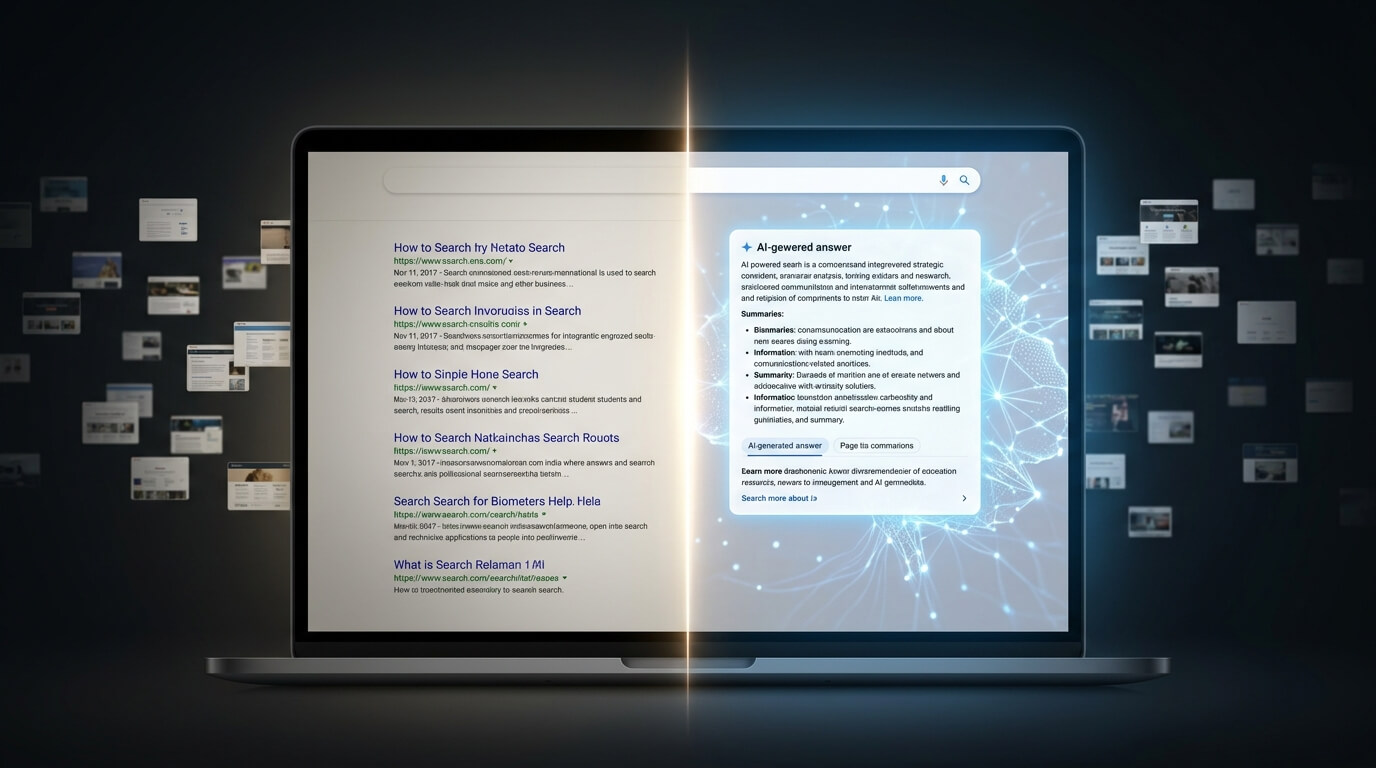
Quick answer: Google is no longer just a gateway to the internet, it’s becoming the destination itself. In 2026, roughly 60% of all Google searches end without anyone clicking a single link. AI Overviews now appear on 48% of all queries. Publishers are losing 20–40% of their traffic. And Google’s new AI Mode takes it even further, with 93% of those searches ending in zero clicks. For everyday users, search is getting faster and more useful. For the websites that built the internet, it’s an existential threat.
Here’s what’s actually happening, what the real numbers show, and what it all means, whether you’re a regular user, a business owner, or just someone who’s noticed that Google looks and behaves very differently than it did two years ago.
What Google Search Used to Look Like
For nearly 25 years, Google’s homepage was the same: a clean white page, a search box, and ten blue links pointing to websites around the internet. You typed something, Google found the best pages, and sent you there. Simple. Every click meant traffic to a website, and that traffic was the engine that funded most of the open internet, news outlets, blogs, recipe sites, tech guides, shopping comparison tools, small business pages.
Google made money from ads alongside those ten blue links. Publishers made money when people arrived on their pages. The whole system was built on traffic, and Google was the world’s most powerful traffic generator.
That model is now being dismantled, one AI-generated answer at a time.
What Changed: AI Overviews, AI Mode, and the New Google
Google made two major moves that changed everything:
AI Overviews launched in May 2024 and are now permanent. Instead of showing ten blue links when you search for something, Google generates an AI-written summary at the very top of the results, pulling information from multiple websites and synthesizing it into a paragraph or two, with a few small citation links tucked underneath. You get the answer. You often don’t need to go anywhere else.
AI Mode launched in 2026 and goes much further. It’s a fully conversational search experience, you ask a question, AI builds an answer, you ask a follow-up, and you stay inside Google’s interface the entire time. Google’s head of search Liz Reid called it “AI search through and through.” The redesigned search box at the top of Google’s homepage now expands dynamically for longer queries and accepts images, videos, and files alongside text what Google calls “multimodal” search.
At Google I/O 2026, the company confirmed that AI Mode has already surpassed one billion monthly users.
The Numbers: What’s Actually Happening to Search Traffic
This is where the story becomes impossible to ignore. The data is unambiguous and striking.
Zero-click searches:
- 60% of all Google searches now end without any click to a website up significantly from prior years
- For news-related searches specifically, 69% end with zero clicks
- When AI Mode is active (the full conversational interface), 93% of searches end without a click
Click-through rate collapse:
- When an AI Overview appears on a results page, only 8% of users click any organic result
- Without an AI Overview, that number is 15% meaning a single SERP feature has cut click behavior nearly in half
- When AI Mode is active, paid click-through rates also dropped 68%, from 19.7% to 6.34%
Publisher traffic losses:
- Google search traffic to publishers fell 33% globally in the year to November 2025
- US publishers were hit harder, at minus 38%
- Some individual publishers experienced far worse: HubSpot lost an estimated 70–80% of organic traffic; CNN saw a 27–38% decline
- Smaller sites lost 60% of search referrals over two years compared to 22% for larger publishers
- One-third of publishers surveyed said they plan to block Google AI Overviews entirely, cutting off the very content that feeds Google’s AI answers
Google’s own position: Despite all of this, Google Search revenue hit $63.07 billion in Q4 2025 alone, a 17% year-over-year increase and Alphabet’s annual revenue exceeded $400 billion for the first time. Total search impressions have actually increased 49% since AI Overviews launched in May 2024. Google is doing this while generating more revenue, not less.
What Google Says vs. What Publishers Experience
Google’s official position is that AI Overviews are good for everyone. The company says AI Overviews drive a 10% increase in Google usage for the types of queries that show them, and that clicks from AI Overviews are “higher quality” even if there are fewer of them. Search head Liz Reid told NPR that users now ask longer, more natural questions because AI handles them better and that this actually helps Google understand when users shift from researching to buying, allowing for more relevant ads.
Publishers experience it differently. The Daily Mail’s desktop click-through rate dropped from 25.23% to 2.79% when an AI Overview appeared above their content, an 89% collapse. Bauer Media’s global director of SEO confirmed to the BBC: “We’re definitely moving into the era of lower clicks and lower referral traffic for publishers.” The Reuters Institute reported in January 2026 that media executives expect search referrals to fall 43% over the next three years.
Both things can be true: Google is making search more useful for users while simultaneously draining the economic model that sustains the web.
Why This Is a Problem Beyond Just Traffic Numbers
When publishers lose traffic, they lose advertising revenue. When they lose revenue, they can’t afford journalists, editors, writers, or developers. When content production declines, there’s less new information on the web. And here’s the circular problem: Google’s AI needs that content to function. AI Overviews are built by synthesizing information from websites. If websites stop producing because Google stopped sending them traffic, the source material for Google’s AI answers eventually dries up.
Lily Ray, VP of SEO strategy at Amsive, warned that the changes would have what she called “a devastating impact on the Internet.” UCLA researcher Sarah T. Roberts put it directly: the algorithmic complexity that already made Google’s results opaque is becoming even more so with AI. “Adding AI will only make the system more opaque,” she told NPR.
Multiple news organizations have already filed lawsuits against Google and OpenAI, arguing that summarizing their content without compensation or a pathway to traffic is economic harm, not fair use.
Who Is Actually Winning Right Now
Counterintuitively, not everyone is losing. The data reveals a distinct split between those being cited by AI Overviews and those being bypassed.
Brands cited within AI Overviews earn 35% more organic clicks and 91% more paid clicks than brands that sit just below the AI answer in position one. In Digital Applied’s March 2026 data, branded queries with AI Overviews actually show an 18% increase in click-through rates, AI is redistributing clicks toward cited sources rather than uniformly suppressing all traffic.
The new dynamic: being cited is the new ranking. Position one below an AI Overview is less valuable than being referenced inside it. This is a fundamental shift in how visibility on Google works.
Content types are not equally affected either. AI Overviews appear on informational queries at an 89% rate — how-to guides, tutorials, explanations. They appear on e-commerce and shopping queries at only 3–4%, because Google initially tested AI answers for product searches and found they didn’t convert into sales. If your business is primarily transactional, selling products or services, your traffic is far more protected than if you publish informational content.
Google’s New Agentic Features: The Next Stage
Beyond answering questions, Google is now building what it calls “agentic” functionality into search. This means Google can be asked to do tasks on your behalf over time, scan for theater tickets at regular intervals, alert you when a product goes on sale, conduct a weekly sweep of the internet for local events. You set the task; Google monitors and reports back.
Combined with the shopping integrations already in development, Google is working with retailers to allow purchases to be completed directly within its interface the logical endpoint is a version of Google where users never need to visit any external website at all for an increasing range of tasks.
Carolina Milanesi, an independent tech analyst who spoke to NPR about Google’s changes, identified the core tension clearly: users will gain speed and convenience, but lose visibility and control over where their information comes from, what sources were used, and whether the result reflects genuine quality or a paid placement. “If you’re going to say ‘I want a pair of Jordans, go find them,’ you’re not necessarily sure what steps have been taken,” she said, “or if AI actually went and did their due diligence and picked the best for me as a customer.”
What This Means for You — Depending on Who You Are
If You’re a Regular User
Search is getting faster and easier. Complex questions that used to require visiting three different websites now get summarized in seconds. The tradeoff is less control over your sources and fewer opportunities to discover content beyond what Google’s AI decides to include. If you want to avoid AI Overviews, unofficial browser extensions and search engine alternatives like Kagi, DuckDuckGo, and Brave Search let you opt out.
If You Own a Website or Business
Your SEO strategy needs to evolve immediately. Traditional ranking is no longer sufficient, you need to optimize for citation within AI Overviews as well as traditional results. What helps get cited: strong external brand mentions, high domain authority (sites with over 32,000 referring domains are 3.5x more likely to be cited), clear structured content, and presence on review platforms like G2, Trustpilot, and Capterra. If your content is primarily informational, assume AI Overviews will appear for most of your target queries. If it’s transactional, you’re in a better position for now.
If You Work in Publishing or Journalism
The headline numbers are genuinely alarming a projected 43% decline in search referrals over the next three years, with one in five publishers expecting losses above 75%. The strategic responses vary from blocking AI crawlers (at the risk of losing all Google visibility) to pursuing licensing deals with AI companies to building direct audience relationships through newsletters and social platforms that don’t depend on search traffic.
Frequently Asked Questions
What is Google AI Mode and how is it different from regular Google Search? Google AI Mode is a conversational search interface where you can ask questions in natural language and receive AI-generated answers with follow-up capability, similar to ChatGPT but built inside Google. Regular Google Search still returns blue links alongside any AI Overviews. AI Mode is a more complete shift toward AI-first answers, with 93% of those searches ending without any click to an external website.
What is a zero-click search? A zero-click search happens when a user gets the information they need directly from Google’s results page without clicking through to any website. In 2026, approximately 60% of all Google searches end this way. The rise of AI Overviews is a major driver, if Google summarizes the answer, many users don’t need to go further.
Can I turn off Google AI Overviews? Not officially, there’s no built-in opt-out button. However, several workarounds exist: browser extensions can suppress AI Overviews in results, adding “site:” operators or searching in Verbatim mode can reduce them, and switching to alternative search engines like DuckDuckGo, Brave Search, or Kagi gives you a Google-free search experience with AI features togglable.
Is Google Search traffic declining for all websites? Not equally. Informational content sites face the steepest declines, with AI Overviews triggering on up to 89% of informational queries. E-commerce and transactional sites see AI Overview trigger rates of just 3–4%, leaving their traffic relatively protected. The pattern that emerges: the more your content provides information rather than products, the more your traffic is at risk.
Is ChatGPT replacing Google? Not yet, and not soon. Google holds over 90% search market share despite AI Overviews and the growth of ChatGPT. ChatGPT referrals account for just 0.02% of total publisher referral traffic. ChatGPT is growing as a research and information tool, but it is not yet a search engine replacement at scale. The real competition is Google vs. itself, the question isn’t whether ChatGPT takes over, but how much of the open web survives Google’s own AI transformation.
How is Google making more money if fewer people are clicking on websites? Google earns revenue primarily from ads on its own results pages, not from sending people elsewhere. When AI Overviews appear, users stay on Google longer, which means more exposure to Google’s own ads, even if third-party publishers see fewer clicks. This is why Google’s search revenue grew 17% year-over-year even as publisher traffic declined. The economic benefit of AI search has largely transferred from publishers to Google.
What is agentic search and when is it coming? Agentic search means Google performing ongoing tasks on your behalf, monitoring prices, scanning for events, tracking availability rather than just answering a one-time query. Google introduced this feature at I/O 2026 and it’s already available in AI Mode for US users. Expect it to expand globally through 2026 and 2027.
The Bottom Line
AI is not just changing how Google looks, it’s changing who benefits from the internet. For 25 years, the search economy worked because Google needed websites and websites needed Google. That mutual dependence made the open web thrive. In 2026, that deal is unraveling. Google now answers more questions than it routes. The websites that built the content Google was trained on are losing the traffic that paid for that content’s creation.
The users experiencing this shift get faster, easier answers. The internet that made those answers possible gets less in return every month. How that imbalance resolves, through lawsuits, regulation, licensing deals, or market adaptation, is the defining tech story of the next five years.