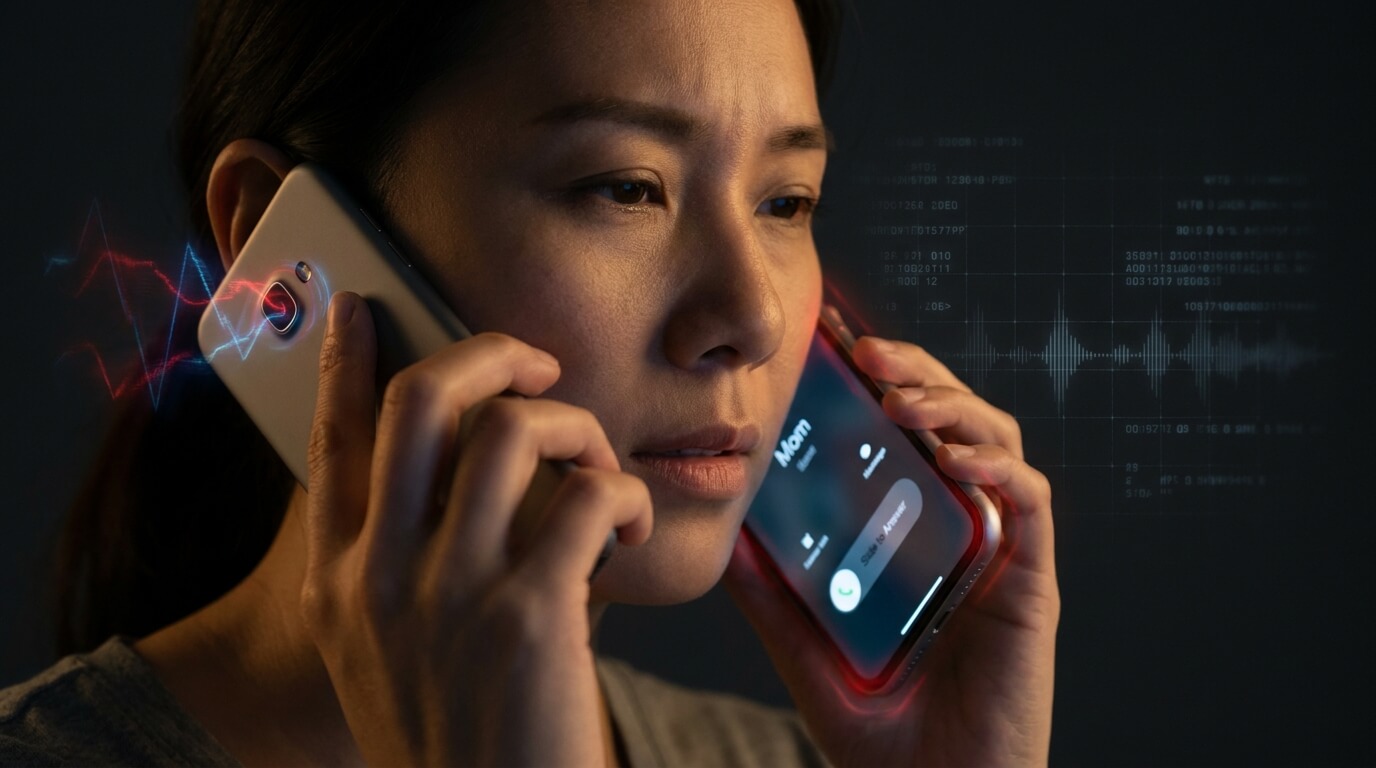
Quick answer: You detect a deepfake voice call by listening for five specific audio tells, robotic flatness, missing breath sounds, unnatural pauses, mispronounced names, and a voice that sounds “almost right” but slightly off and by immediately applying two behavioral checks: ask a question only the real person could answer, and use a pre-agreed family codeword. No single check works every time. Use them together. Most importantly: if you feel pressured to act fast, that urgency itself is the biggest tell of all.
AI voice cloning now requires just three seconds of audio to produce an 85% voice accuracy match, pulled from a TikTok, a voicemail greeting, or a Facebook video. Deepfake vishing attacks surged 1,633% in Q1 2025 versus the quarter before, and 1 in 4 Americans received an AI-generated deepfake call in the past year. The average business loss per deepfake voice incident is $680,000. A Florida mother lost $15,000 in July 2025 after a cloned version of her daughter’s voice called claiming to be in danger. This is not a future threat. It is happening right now, today, at scale.
Here’s how to catch it, with a demonstration of each audio tell so you know exactly what to listen for before a scammer calls.
Why Deepfake Voice Calls Are Suddenly So Convincing
Two years ago, AI voices sounded robotic and unnatural. Today, tools like ElevenLabs, Microsoft VALL-E 2, and OpenAI’s Voice Engine can produce a convincing clone from a clip of audio most people already have publicly available. The voice carries the right accent, the right speaking pace, and the right emotional warmth of the person being impersonated.
What the AI still gets wrong: the biological details of live human speech. Breathing, micro-hesitations, the way a voice changes under real emotional stress, the specific way someone pronounces a nickname they’ve used for 30 years, these are the gaps that still exist in 2026. Every technique below exploits one of those gaps.
Kaspersky security researcher Tom Fosters confirmed in February 2026: “Even top-quality deepfakes trip up when it comes to synchronizing speech with natural breathing and emotional expression. These remain the most reliable detection signals available to everyday people.”
The 8 Ways to Detect a Deepfake Voice Call
1. Listen for the Flat, Emotionless Tone
The most reliable audio tell is one most people can feel before they can name it.
AI-generated voices struggle to match the natural rise and fall of human speech under emotion. Real voices don’t just say the words, they perform them. When your daughter is panicking, her voice breaks. When your boss is urgent, his pace quickens in ways that feel distinctly like him being urgent, not just urgency in general.
What you hear in a deepfake:
- A voice that sounds smooth and composed despite supposedly being in distress
- Emotional content that doesn’t quite match the emotional delivery, the words say “I’m terrified” but the voice sounds like a news anchor
- Pitch that stays too consistent throughout real voices go up and down dramatically under stress
- A vague sense that something is “off” before you can name exactly what
Trust this instinct. Your brain has spent decades learning what this specific person sounds like under pressure. It detects mismatches faster than your conscious mind can process them.
2. Notice the Missing Breath Sounds
This is the single most consistent AI voice tell in 2026 — and almost nobody checks for it.
Real human speech has a rhythm built around breathing. People inhale before long sentences, exhale mid-thought, take micro-pauses that aren’t quite silence. These sounds aren’t loud but they’re present, and they follow a biological logic.
AI voice models often either:
- Remove breath sounds entirely — leaving an unnaturally clean audio track between words
- Place breaths incorrectly — mid-word, mid-sentence, or at intervals that don’t match the length or exertion of what’s being said
- Generate artificial breath sounds that are too regular — the same duration, the same interval, like a metronome
What to listen for:
- Sentences that run together with no audible inhale before them
- A speaking pace that never slows down for breath even in long sentences
- Breaths that appear mid-word where no human would naturally pause to inhale
- A phone call that sounds surprisingly clean — too clean, like a studio recording rather than a live call
3. Ask the Person to Turn or Move — Then Listen to What Happens
Real people exist in a physical space. AI voices don’t.
When a real person moves, walks across a room, turns away from the phone, moves closer to a window their voice interacts with the environment. There are subtle acoustic changes: slightly different room resonance, a shift in background noise, the natural adjustment of someone repositioning while speaking.
Ask the caller to:
- Walk to another room while still talking
- Put the phone down and pick it up again — real phones create a brief handling sound
- Speak from further away, then closer — real voices change with distance in ways that AI doesn’t always replicate
What a deepfake does: continues in exactly the same acoustic environment regardless of what you ask. The voice doesn’t shift. The room doesn’t change. The audio quality stays identical. It’s the voice equivalent of a green screen that forgot to add shadows.
4. Mispronounced Names and Shibboleths
The words a voice has never said are the words it can’t say correctly.
“Shibboleth” is an old word for a test that only insiders can pass. In deepfake detection, it means asking the caller something that requires knowledge they could only have if they’re genuinely who they say they are and specifically, knowledge that was never recorded or posted publicly.
AI voice clones are built from audio samples. They can only produce sounds and inflections present in those samples. A voice clone of your brother can’t know:
- The nickname you’ve called him since childhood that was never said on camera
- The way he pronounces your parents’ names — his specific, personal version
- A local place name with an unusual pronunciation known only to locals
- An inside joke phrase your family uses that has no public recording
Questions to ask immediately when something feels wrong:
- “What do you call Dad?” (if the real person has a family nickname for a parent)
- “Say [local street or area with unusual pronunciation]”
- “Finish this: [beginning of a private phrase only they know]“
The AI will either:
- Produce a generic, formal version of the name or phrase
- Stumble or repeat if the word pattern is outside its training
- Fall completely silent or redirect the conversation urgently
5. Test the Urgency — Real People Can Wait 60 Seconds
Urgency is not a sign of crisis. In 2026, urgency is the primary sign of a scam.
Every deepfake voice scam in the documented record has one thing in common: you must act now. There is no time to verify. Calling back is impossible or dangerous. Waiting even one minute will cause something terrible to happen.
This manufactured urgency exists because the scam collapses the moment you pause. If you hang up and call your daughter on her real number, the scam is over. The scammer knows this. So the AI is scripted to make you feel that pausing is the dangerous choice.
Real emergencies do not work this way. A real family member in a real crisis will always prefer you to verify before acting. A real boss asking for an urgent wire transfer will understand a 60-second callback. Real people can wait 60 seconds.
The test:
- Simply say: “Hold on — I’m going to call you right back on your regular number to confirm this.”
- A real person: “Yes, of course, do that.”
- A deepfake scammer: escalating reasons why you absolutely cannot do that, right now, this second
6. Listen for Unnatural Pauses and Robotic Pacing
Real people make mistakes. AI voices don’t and that’s what gives them away.
Natural human speech includes constant micro-imperfections: words slightly run together, brief stumbles when a thought changes direction, self-corrections, emphasis that doesn’t always land on the “right” syllable. These imperfections have a biological rhythm, they follow the pattern of a brain forming thoughts in real time.
AI speech is generated from a trained model that predicts optimal audio outputs. That prediction process creates speech that is:
- Too perfectly paced — pauses occur exactly where grammar says they should, not where a living person’s breath and thought pattern would place them
- Free of self-corrections — real people say “I mean— what I meant was” constantly; AI voices almost never do
- Unnaturally consistent in rhythm — the tempo of the voice doesn’t change the way a real person’s does when they’re thinking, distracted, or under stress
- Paused at complete clause boundaries — artificial pauses between every major clause, rather than the irregular, breath-driven pauses of real speech
This one is subtle, but once you’ve heard it, you can’t un-hear it.
7. Use the Family Codeword — Set One Up Before You Need It
The family codeword is the single highest-leverage defense against voice deepfake scams — and it costs nothing.
The FBI recommends it. The FTC recommends it. AARP recommends it. Kaspersky security researchers recommend it. Every major cybersecurity organization recommends the same thing: establish a secret word or phrase with close family members that could only be known to them, and use it as an identity check when something feels wrong.
An AI voice clone cannot know a codeword that was:
- Never said aloud in any recording that exists publicly
- Never typed in any message that could have been accessed
- Never posted online in any form
How to set up a family codeword:
- Choose a phrase that is completely random and unmemorable to outsiders — not a pet’s name, not a birthday, not a song lyric. Something like “Purple Avocado” or “Midnight Station.”
- Share it only in person — never by text, email, or any digital channel
- Agree on the rule: if someone calls claiming to be a family member in an emergency, ask for the codeword immediately, before taking any other action
- Change it once a year or if you suspect it has been compromised
- Do not make exceptions — a real family member will understand immediately
8. Hang Up and Call Back on a Number You Already Have
The single most reliable deepfake voice detection technique requires no technology at all.
Hang up. Call back. On a number you already have, from your contacts, from a previous communication, from a company’s official website. Not a number the caller gave you. Not a number they said to “use in an emergency.” A number you had before this call started.
This defeats every deepfake voice scam, without exception, because:
- The scammer cannot intercept a call to a number they didn’t give you
- The real person either answers (confirming the scam) or doesn’t (in which case the alleged emergency needs more verification)
- It costs you 30 seconds — and if the situation was truly an emergency, 30 seconds changes nothing
What scammers do to prevent this: they give you a different callback number, they say the regular number isn’t working, they create urgency that makes you feel the callback will arrive too late. These responses are themselves confirmation that something is wrong. A real person in a real crisis always prefers you to verify.
Real-World Scams Using Deepfake Voices Right Now
Understanding the detection techniques is more powerful when you know exactly what’s being deployed against people in 2026:
The Family Emergency Call — AI-cloned voice of a child or grandchild claiming to be in a car accident, in jail, or in danger, asking for immediate money transfer. A Florida mother lost $15,000 in July 2025 to this exact scam. The FBI documented cases where scammers simulated kidnappings demanding ransoms of $2,500–$15,000. The tell: extreme urgency, inability to accept a callback, request for untraceable payment (Bitcoin ATM, gift cards, wire transfer).
Executive Impersonation (BEC 2.0) — A cloned CEO or CFO voice on a “urgent” phone call instructing an employee to wire funds or share credentials before end of business. The Arup engineering company wired $25.6 million across 15 transactions after a deepfake video call with a “CFO” the employee had suspected the original email was phishing, but the live video call erased all doubt. Organizations lose an average of $680,000 per deepfake voice fraud incident.
The Bank Fraud Agent Call — AI-generated voice impersonating a bank’s fraud department, warning that your account has been compromised and you must “move your funds to a safe account” immediately. The callback number provided goes back to the scammer. The real bank’s number, the one on your card — does not.
The Government Authority Call — Cloned voice of an IRS agent, police officer, or Social Security Administration representative threatening arrest or account closure unless immediate payment is made. Government agencies never demand payment by phone or request gift cards, crypto, or wire transfers.
Free Tools That Help — and What They Can’t Do
Tool |
What It Does |
Key Limitation |
|---|---|---|
McAfee Deepfake Detector |
Real-time audio analysis on-device |
96% lab accuracy; drops significantly against tools it wasn’t trained on |
Hiya Deepfake Voice Detector |
Browser extension/mobile authenticity score |
Consumer-facing; best for flagging, not confirming |
Pindrop Pulse |
Enterprise call center liveness detection |
Enterprise-only, not consumer-facing |
Resemble AI Detect |
Upload audio for AI detection score |
Requires audio file; not usable in real-time on a live call |
Reality Defender |
Enterprise deepfake detection for banks and insurers |
Enterprise/institutional; not consumer-accessible |
The honest limitation: detectors that score 94–96% accuracy in lab conditions collapse to below 50% against tools they weren’t trained on. No tool reliably catches every deepfake voice in a live call context. The behavioral checks in this article codeword, callback, urgency test are more reliable in real-time than any app currently available to consumers.
Frequently Asked Questions
How little audio does a scammer need to clone my voice? As little as three seconds, according to McAfee research and documented in multiple 2026 fraud reports. Tools like Microsoft VALL-E 2 and ElevenLabs can produce an 85% voice accuracy match from a short clip. Sources include TikTok videos, voicemail greetings, YouTube uploads, podcast appearances, and public social media posts.
What is the single most reliable way to detect a deepfake voice call? The family codeword combined with a callback on a number you already have. These two techniques require no technology, work in real time, and cannot be defeated by even the best voice cloning tools because they exploit knowledge the AI was never given, and a communication channel the scammer didn’t establish.
Can I trust caller ID to tell me if a call is real? No. Caller ID can be spoofed, scammers can make a call appear to come from any number they choose, including your family member’s real number or a bank’s official customer service line. Caller ID confirms nothing about whether the voice on the call is real.
What should I do if I think I’m receiving a deepfake call right now? Stay calm and don’t act on any request. Say you’ll call back in 60 seconds. Hang up. Call the person on the number in your contacts. If it’s a company, find their number on their official website, not a number the caller gave you. If you feel you cannot do this safely, simply end the call.
What are the most common targets of deepfake voice scams? Anyone with a family, and anyone who handles money at work. FBI data shows 44% of people in their 20s who were targeted by AI fraud lost money. Seniors lose the most per incident (median $1,650 for ages 80+). Businesses are targeted through executive impersonation, the average enterprise loss is $680,000 per incident. No demographic is immune.
Can I protect my voice from being cloned? You can reduce the available material by making social media profiles private, limiting public videos containing your voice, and being cautious about what you share publicly. But complete protection is not realistic for most people who have any public digital presence. The more effective strategy is preparing your defenses, especially the family codeword rather than trying to eliminate all source audio.
What happens if I already sent money to a deepfake scammer? Contact your bank or financial institution immediately to attempt to freeze or reverse the transaction. Report to the FTC at ReportFraud.ftc.gov, and to the FBI at ic3.gov, specifically mention that AI voice cloning was involved. Contact your state attorney general’s office. Act within the first hour, some wire transfers can be recalled if reported quickly enough.
Are businesses doing anything to stop deepfake voice fraud? Yes, though inconsistently. Enterprise-grade tools like Pindrop Pulse are deployed in many bank call centers to analyze voice “liveness” in real time. The Take It Down Act (signed 2025) addresses some deepfake content, but not audio specifically. Multiple states enacted AI fraud regulations effective January 2026. The FBI IC3 formally categorized AI-related crimes for the first time in its 2025 annual report. Progress is real, but the legal and technical landscape is still catching up to the threat.
The Bottom Line
Deepfake voice technology has made the phone the most dangerous attack surface in modern fraud. The scams that use it are simple, emotionally devastating, and fast, designed to make you act before you think.
The defenses are equally simple. Set up a family codeword this week, today if possible. Share it only in person. Decide right now that you will always hang up and call back before sending money to anyone who calls you. Know what a flat, breathless, unnaturally smooth AI voice sounds like. And remember: if any caller is telling you there is no time to verify, that pressure is the scam itself.
The technology clones the voice. It cannot clone the knowledge, the codeword, or the 30 seconds it takes to call someone back on a number you already have.